
When planning a construction project, choosing between a steel pipe and a steel tube is not always as simple as comparing sizes and prices. Both are hollow steel products, but they can be specified differently depending on their application, dimensions, wall thickness, grade and manufacturing method.
For contractors, engineers, fabricators and procurement teams, the better approach is to start with the project requirement and then select the appropriate product. The right choice depends on what the section needs to do, how it will be fabricated and which standard applies.
What Is the Difference?
Steel pipes are commonly associated with applications where the product carries fluids or gases, such as water systems, industrial services and infrastructure. However, circular pipes can also be used in structural applications.
Steel tubes are widely used for structural and mechanical purposes. They are commonly specified using their outside dimensions and wall thickness, while pipes are often identified using nominal pipe sizes and related dimensions.
The main differences to consider are:
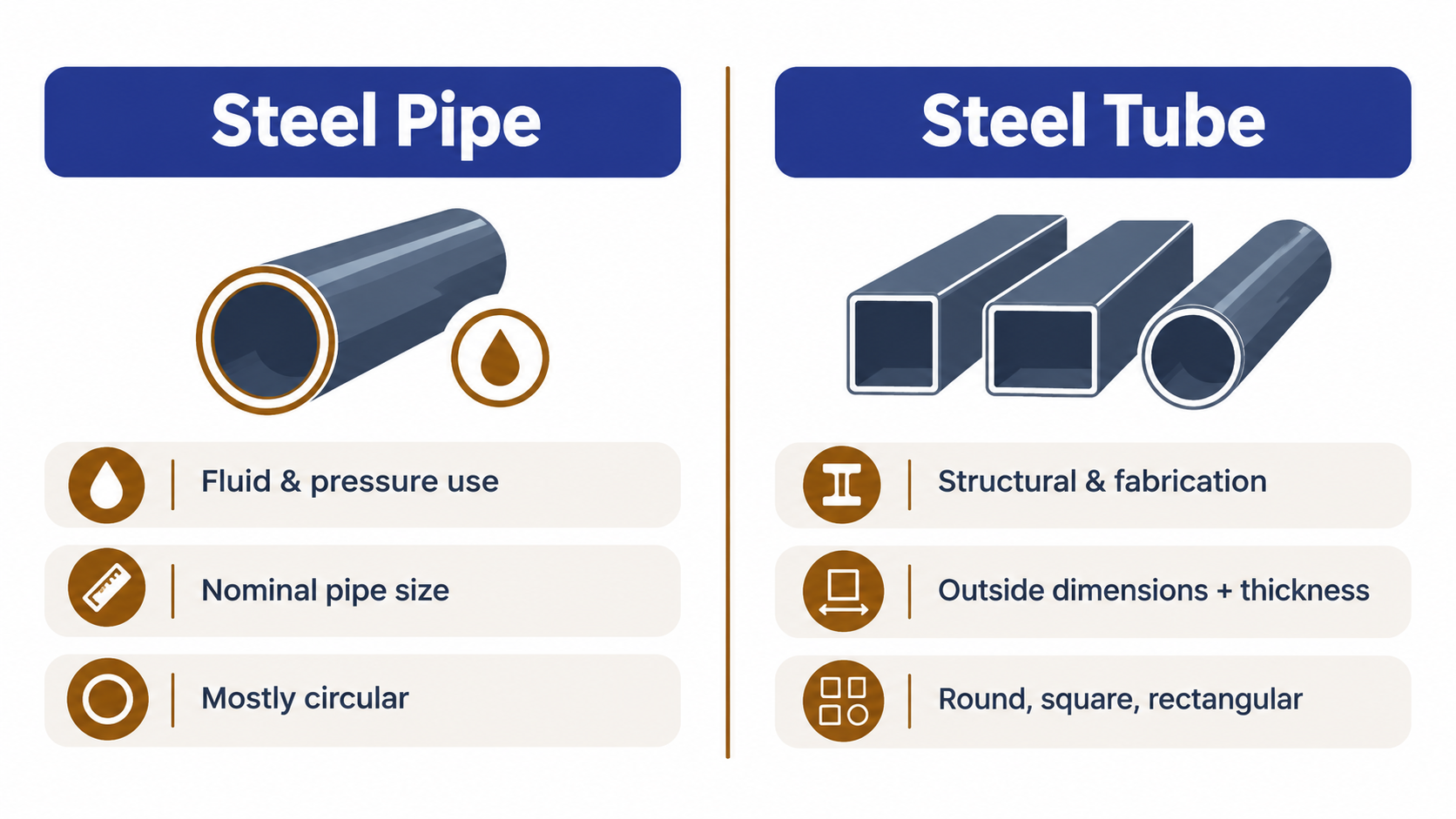
- Purpose: Pipes are commonly used for fluid or pressure-related applications, while tubes are widely used for structural and fabrication work.
- Shape: Pipes are commonly circular, while tubes are available in circular, square and rectangular forms.
- Dimensions: Pipe sizing and tube sizing use different conventions, so the two should not be treated as interchangeable.
- Wall thickness: Thickness should be selected according to the application and specification.
- Manufacturing method: Products may be manufactured using welded or seamless processes depending on the required specification.
- Project requirements: Application, load, fabrication, standard and service conditions should guide product selection.
So, the question is not simply whether pipes or tubes are better, the important question is which product matches the project requirement.
When Should You Choose Steel Pipes?
Steel pipes are commonly considered for applications such as:
- Water and fluid transportation
- Industrial services
- Infrastructure systems
- Utility applications
- Structural applications using circular sections
For example, a pipe used for fluid transportation will need to meet requirements related to its service conditions and applicable standard. A circular section used as part of a structure will have different design considerations.
Carbon steel pipe may also be considered when its material properties, grade, service conditions and applicable standard match the project requirement.
Before ordering, avoid specifying only the diameter or nominal size. The manufacturer may also need information about wall thickness, grade, standard, application and required quantity.
When Are Steel Tubes Better Suited for Construction?
Structural tubing is commonly used when the hollow section forms part of a fabricated structure. The section shape can affect load distribution, connection details, fabrication and available space.
Common options include:
Square Steel Tubing and SHS
Square Hollow Sections (SHS) have equal width and depth. They are often considered for:
- Structural frames
- Columns
- Gates
- Railings
- Staircases
- Fabricated structures
The four flat faces can also make welding, drilling and bolting more convenient.
Rectangular Hollow Sections and RHS
Rectangular Hollow Sections (RHS) have different width and depth dimensions. This makes them useful where the design requires a deeper section in one direction.
Typical applications include:
- Frames
- Roof structures
- Columns
- Trusses
- Fabricated structures
Circular Hollow Sections and CHS
Circular Hollow Sections (CHS) are useful where a round profile suits the structural design, fabrication requirements or appearance. They are commonly considered for columns, trusses, railings and other fabricated structures.
The section should always be selected based on engineering requirements rather than appearance alone.
Seamless Pipe vs Welded Pipe
Steel pipes and tubes may be manufactured using different processes, including welded and seamless methods.
A welded product has a longitudinal welded seam, while a seamless product is manufactured without a longitudinal welded seam.
This does not mean that seamless pipe is automatically stronger or better. The appropriate manufacturing method depends on factors such as:
- Application
- Pressure or service requirements
- Dimensions
- Material specification
- Applicable standard
- Project requirements
If a project specification calls for a particular manufacturing method, this should be clearly mentioned in the purchase enquiry. Otherwise, the manufacturer should understand the application and relevant specification before recommending the appropriate product.
SHS vs RHS vs Round Sections for Construction
Section shape has a direct effect on fabrication and structural design.
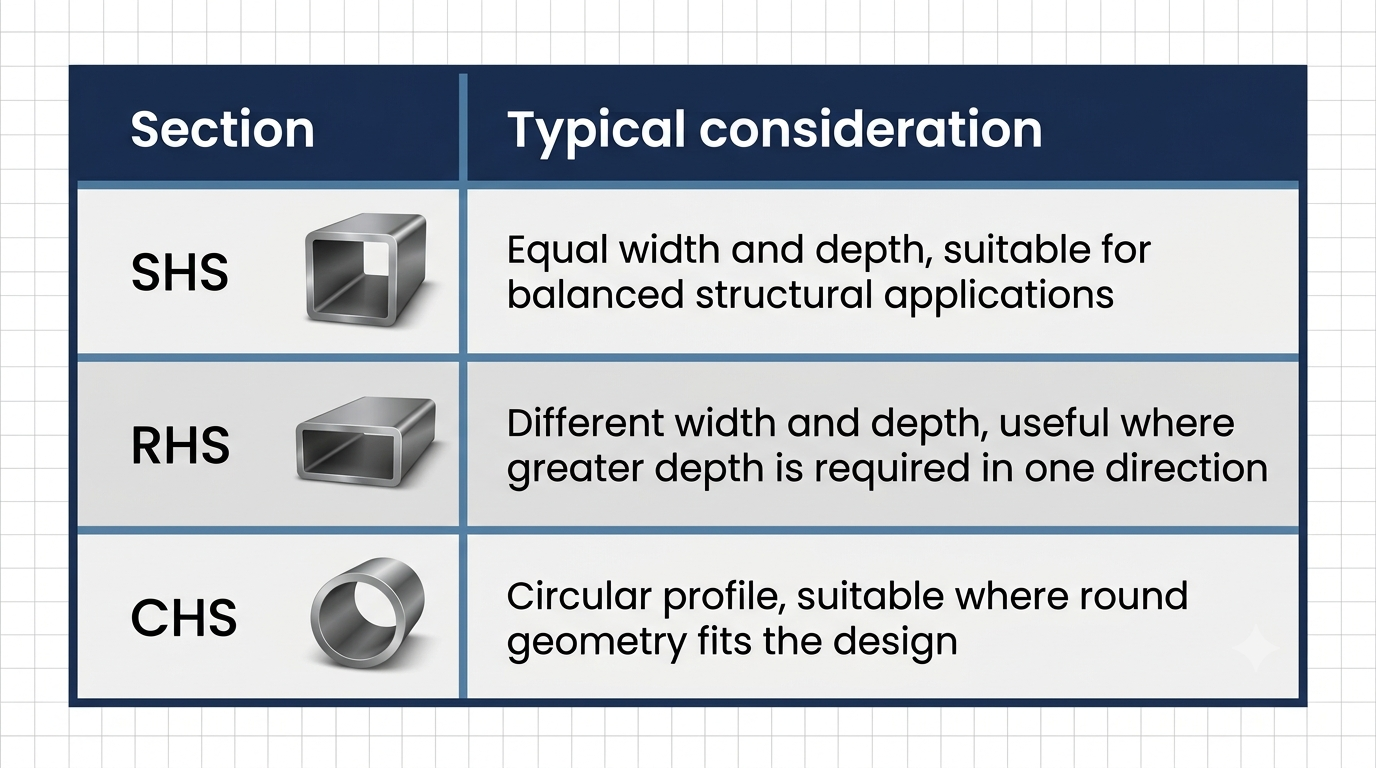
For a fabricated frame, SHS may suit a design requiring equal dimensions. RHS may be considered when the section needs greater depth in one direction. CHS can be useful when a circular profile fits the structural geometry or architectural requirement.
The final selection should come from the engineering design, connection details and fabrication requirements.
Choose the Right Steel Product for Your Project
A practical selection process can follow these steps:
1. Identify the application
First determine whether the product is required for fluid service, structural framing, fabrication, roofing, railing or another purpose.
2. Check the structural requirement
For structural applications, consider the required loads, span, support conditions and connection details.
3. Select the section shape
Decide whether CHS, SHS, RHS or another section is appropriate.
4. Confirm dimensions and wall thickness
Specify the required outside dimensions or pipe size along with wall thickness. Do not assume that nominal pipe size and tube dimensions mean the same thing.
5. Confirm the steel grade
The required grade should come from the project specification and design requirements.
6. Check the manufacturing method
Confirm whether welded, seamless or another manufacturing method is required.
7. Identify the applicable standard
The product should be ordered according to the relevant project or product standard.
8. Consider fabrication
Check how the product will be cut, drilled, welded, bolted or connected during fabrication.
9. Consider environmental conditions
Outdoor, humid, chemical or other demanding environments may require specific surface or corrosion protection requirements.
10. Confirm quantity and delivery
Provide the required quantity, length, delivery location and expected delivery schedule.
11. Confirm quality documentation
Check whether the project requires material certificates, test reports, inspection documents or other quality records.
What Should You Tell a Steel Manufacturer Before Ordering?
A clear purchase enquiry saves time during quotation and order processing.
Provide the following information wherever applicable:
- Product type
- Section shape
- Size or dimensions
- Wall thickness
- Steel grade
- Applicable standard
- Required quantity
- Intended application
- Required length
- Surface or coating requirements
- Delivery location
- Required certificates or test documents
Instead of sending a request such as “Need steel tubes for a warehouse,” provide the complete specification available from the project documents.
This gives the manufacturer a clearer understanding of what needs to be supplied and reduces unnecessary clarification during procurement.
Common Mistakes When Selecting Steel Pipes or Tubes
Choosing only by price
A cheaper product may not match the required grade, thickness, dimensions or standard.
Selecting a section without checking the application
A section suitable for a railing may not be appropriate for a load-bearing structural member.
Confusing pipe size with tube dimensions
Nominal pipe size and actual tube dimensions are different ways of specifying products. Always check the required dimensional system.
Ignoring wall thickness
Products with similar outside dimensions can have different wall thicknesses and weights. Thickness should match the design and specification.
Selecting a grade without checking requirements
Do not select a material grade simply because it is readily available. Confirm the grade required for the project.
Ignoring fabrication requirements
Cutting, welding, drilling, bending and connection details should be considered before finalising the product.
Comparing products only by appearance
Two products can look similar while having different grades, dimensions, thicknesses and manufacturing specifications.
Steel Pipe or Tube: The Right Choice Depends on the Project
There is no single answer to whether a steel pipe or tube is better for construction. The appropriate choice depends on the intended application and the requirements established by the project.
Before placing an order, check:
- Application
- Structural or service requirements
- Section shape
- Dimensions
- Wall thickness
- Steel grade
- Manufacturing method
- Applicable standard
- Fabrication requirements
- Environmental conditions
- Quantity and delivery
- Quality documentation
For construction projects requiring circular, square or rectangular hollow products, AMMAN-TRY provides steel pipes and tubes including CHS, SHS and RHS. Buyers can use the project specification and application details to identify the appropriate product and communicate the requirement clearly to the manufacturer.
The goal is not to choose between pipe and tube based on a general preference. It is to select the product that matches the design, specification, fabrication process and final use of the project.
FAQs
How do I choose between a steel pipe and structural tube?
Start with the application. Consider whether the product is required for fluid service, structural framing or fabrication, then check dimensions, wall thickness, grade, manufacturing method and applicable standards.
What information should I provide when ordering steel tubes?
Provide the section type, dimensions, wall thickness, grade, standard, quantity, required length, application, surface requirements and delivery location.
Are square hollow sections suitable for structural frames?
SHS can be used for structural frames when the section size, thickness and material meet the engineering requirements. The final selection should be based on the loads and connection design.
When should I consider seamless pipe?
Consider seamless pipe when the project specification, service conditions, pressure requirements or applicable standard require it. It should not be selected simply on the assumption that seamless is always better.
What is the difference between SHS and RHS?
SHS has equal width and depth, while RHS has different width and depth dimensions. The choice depends on the structural design, load direction, connection details and available space.
Does wall thickness affect steel tube selection?
Yes. Wall thickness affects the section’s weight, dimensions, fabrication and structural characteristics. The required thickness should come from the project specification and engineering requirements.
What should I check in steel pipe quality documentation?
Check the material, grade, dimensions, applicable standard and required chemical or mechanical test information. Also confirm whether the project requires specific inspection reports or certificates.
