
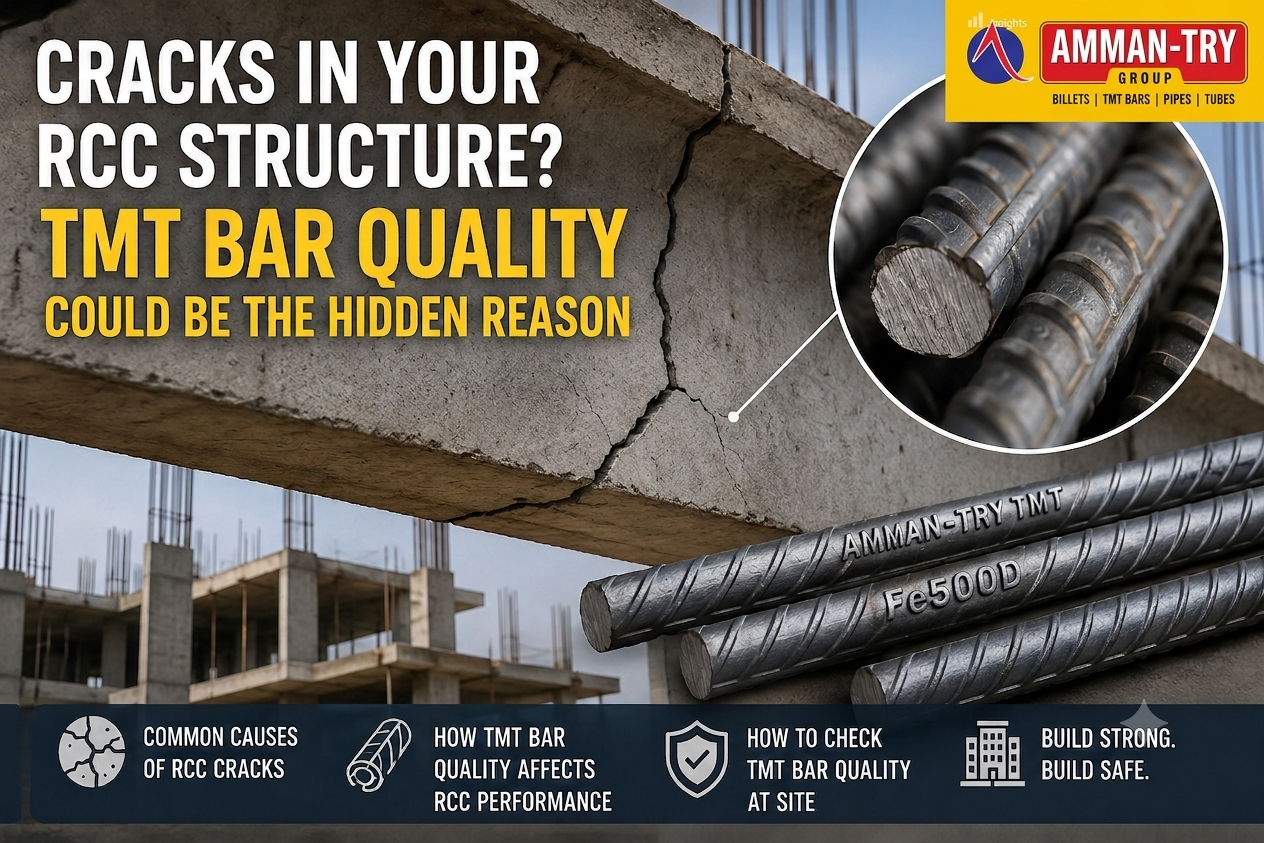
During an RCC construction project, the real worry often begins after the concrete sets. A beam may look fine initially, but weeks later cracks start appearing, raising an urgent question: what is actually causing them?
While concrete mix, curing, shrinkage, detailing, workmanship, and structural loads are common factors, the reinforcement steel inside also deserves attention. TMT bar quality can influence strength, ductility, bending performance, and bonding with concrete. This makes reinforcement steel one factor worth considering during an investigation, without assuming it is solely responsible for the crack.
What Can Cause Cracks in an RCC Structure?
An RCC structure works because concrete and reinforcement steel work together. Concrete mainly handles compression, while reinforcement helps carry tensile forces.
If either the material or the construction process is not right, cracks can appear.
Common causes include:
- Poor concrete mix or inconsistent batching
- Excess water added to concrete at site
- Inadequate or improper curing
- Concrete shrinkage during drying
- Incorrect reinforcement placement or detailing
- Structural movement or excessive loading
- Corrosion of reinforcement
- Poor workmanship during concreting
- Unsuitable or poor-quality reinforcement steel
For example, a surface crack caused by drying shrinkage is very different from a structural crack associated with excessive loading. Similarly, corrosion-related cracking has a different pattern and cause.
So, seeing a crack does not automatically mean the TMT bars are defective. The location, width, direction, depth, age of the crack, and surrounding construction conditions all matter.
How Can TMT Bar Quality Affect RCC Performance?
Good reinforcement steel is not simply about having a high strength number. Its mechanical properties, chemical composition, dimensions, surface condition, and manufacturing consistency all matter.
1. TMT Bar Strength
TMT bar strength determines the specified strength level of reinforcement.
Using the correct grade for the structural design is important. Choosing steel simply because it has a higher strength value is not necessarily the right approach. The reinforcement grade should match the structural design and project requirements.
When selecting TMT bars for an RCC project, including options such as AMMAN-TRY TMT bars, the focus should remain on choosing the appropriate grade and properties for the structural application.
2. Ductility Matters More Than Many Sites Realise
A structure does not always experience load in a perfectly predictable way. Reinforcement may need to deform under stress before failure.
This is where the ductility of TMT bars becomes important.
Ductile reinforcement can undergo greater deformation before breaking. This gives the structure greater ability to accommodate certain stresses and movements rather than experiencing sudden failure.
This is one reason Fe500D TMT bars may be considered where higher ductility is required by the design or project conditions. The “D” grade indicates enhanced ductility requirements compared with standard Fe500 reinforcement.
However, the correct grade should always be selected based on the structural design rather than simply choosing Fe500D because it is marketed as a better option.
3. Elongation and Bending Performance
Think about what happens at a construction site when reinforcement bars are bent into stirrups, hooks, or other shapes.
If the steel does not have the required ductility and bending characteristics, improper bending can result in cracks or other visible damage to the bar.
A bar that performs properly during bending and rebending helps maintain the intended reinforcement arrangement.
This is particularly important when TMT bars for RCC construction are being cut and bent at site.
Avoid using gas torches or uncontrolled direct heating as a routine method for bending or straightening TMT bars. Heating can alter the metallurgical condition and mechanical properties of reinforcement. Any heating procedure should only be used when specifically permitted by the applicable engineering procedure.
If a bar develops cracks during normal bending, stop the work and investigate the material and bending method before continuing.
4. Bond Between Steel and Concrete
RCC depends on the interaction between concrete and reinforcement.
The ribs on TMT steel bars help create mechanical interaction with the surrounding concrete. If the bar surface, rib pattern, or dimensions are inconsistent with the required specification, the expected bond behaviour may not be achieved.
That does not mean every unusual-looking rib automatically indicates poor steel. The reinforcement should be checked against the applicable specifications and test requirements.
5. Chemical Composition and Manufacturing Consistency
Steel chemistry affects properties such as weldability, ductility, and overall mechanical performance.
For this reason, reinforcement steel quality should be verified through proper documentation and testing rather than judged only by appearance.
Consistency in manufacturing is also important because reinforcement used throughout an RCC structure needs to meet the properties specified for the project.
Warning Signs to Check Before Using TMT Bars
A quick site inspection can identify reasons to investigate further.
Look for:
- Deep surface defects, cracks, or unusual scaling
- Excessive rust beyond normal surface oxidation
- Clearly inconsistent rib patterns
- Unusual variation in bar diameter
- Unknown manufacturer or supply source
- Missing or unclear grade identification
- Material documentation that is unavailable or inconsistent
- Problems noticed during bending or rebending
- Bars that appear significantly different from the specified material
But remember: appearance alone cannot prove TMT bar quality.
Light surface rust, for example, does not automatically mean the reinforcement is unusable. Similarly, a visually good-looking bar can still require testing to confirm its mechanical and chemical properties.
How to Check TMT Bar Quality Before Using It
Before TMT bars for construction are incorporated into an RCC structure, the site team should verify the material against the project specification.
Use this practical TMT bar quality check:
1. Verify the Grade
Check whether the supplied material matches the grade specified by the structural design, such as Fe500 or Fe500D, where applicable.
2. Check Manufacturer Identification
Confirm the manufacturer’s identification markings on the bars and bundles. The supplied material should be traceable to the relevant purchase and delivery records.
3. Review the Mill or Material Test Documentation
Check the available documentation for relevant mechanical and chemical properties. Where batch or heat details are provided, match them with the delivered material so the test information can be traced to the actual steel used at the site.
4. Check Diameter and Weight
Measure the bar diameter and compare the supplied quantity and mass with the specified requirements.
A theoretical nominal mass can be estimated using:
Weight (kg/m) = d² / 162
where d is the nominal bar diameter in millimetres.
For example, a 12 mm bar has a theoretical nominal mass of approximately 0.89 kg/m.
The calculated value should not be treated as an exact pass-or-fail measurement. Actual measurements should be compared with the applicable permissible tolerances.
5. Verify Bend and Rebend Performance
Where required by the project specification, confirm that the steel meets the relevant bend and rebend requirements. Site bending should also follow the approved method.
6. Store Reinforcement Correctly
Keep TMT bars off the ground and away from standing water, mud, chemicals, and other contaminants. Proper storage reduces unnecessary deterioration before the steel reaches the concrete.
Cracks Have Already Appeared. What Should You Do?
Do not immediately assume that replacing the TMT bars or covering the crack with plaster will solve the problem.
First, document the crack.
Record:
- Where it appears
- Its approximate width and length
- Whether it is horizontal, vertical, diagonal, or irregular
- Whether it is increasing over time
- Whether it occurs in a beam, slab, column, wall, or other location
- Whether there are signs of dampness or reinforcement corrosion
Also review the concrete mix, curing process, reinforcement drawings, construction sequence, loading conditions, and material records.
If the project uses reinforcement such as AMMAN-TRY TMT bars, the relevant material records can form part of this overall investigation, just as they would for reinforcement from any other manufacturer.
If the crack is significant, recurring, widening, or appears in a structural member such as a beam or column, have it assessed by a qualified structural engineer.
The engineer can determine whether the issue relates to reinforcement, concrete, design, workmanship, loading, movement, corrosion, or another cause and recommend the appropriate repair method.
Final thought
Good TMT bar quality is an important part of RCC construction, but it should not be treated as the explanation for every crack.
A properly performing RCC structure depends on several factors working together: suitable reinforcement steel, correct detailing, good-quality concrete, proper placement, adequate curing, workmanship, and design that matches the expected loads and conditions.
Whether selecting AMMAN-TRY TMT bars or reinforcement from another manufacturer, the focus should remain on choosing the appropriate grade and material properties for the structural application.
If cracks appear, investigate the entire system rather than blaming a single material. And before using TMT bars, verify the grade, manufacturer, material documentation, dimensions, mechanical properties, bending performance, and site handling. A simple material check before concreting can help identify potential issues before they become larger construction concerns.
